
The Centre's retreat from the farm laws is likely to have a significant bearing on the fate of laws that the Centre has made, for instance, in labour and electricity, predicts A K Bhattacharya.

GST 2.0 may cushion consumers against US tariffs, but like the 2019 corporate tax cut, it risks being another tactical fix rather than a structural growth strategy, expects Debashis Basu.

GST Reform 2.0, which trims tax slabs from four to two, signals a push for demand-led growth, and together with recent income tax cuts, sets the stage for sustained economic growth, experts said. The Goods and Services Tax (GST) Council on September 3 approved an overhaul of the indirect tax regime by taxing essentials at 5 per cent and other goods at 18 per cent. A new 40 per cent tax will be applicable on luxury and sin items.
It would seem that the government can announce almost anything it wants, without exciting any opposition. That is a sea change.

Kant, a retired 1980-batch Indian Administrative Service (IAS) officer of Kerala cadre, was appointed as India's G20 Sherpa in July 2022, months before India assumed the G20 Presidency.


Dr T V Somanathan is the first finance secretary to be appointed Cabinet secretary since 1985. His appointment at this juncture seems to carry much meaning for the forthcoming trajectory of reforms and restructuring of India's steel frame.

'During the 5-day visit, Amir Khan Muttaqi would have, conceivably, bumped into our powerful security agencies one way or another and some interaction would have ensued, which, in turn, can lead to future dealings.' 'Indeed, this will be the one crucial template of the Indo-Afghan relationship that Pakistan will be monitoring closely,' points Ambassador M K Bhadrakumar.

'While the President has been critical of India, he has gone out of his way to compliment PM Modi. They have an incredible relationship.'

President Droupadi Murmu's address to the nation on the eve of the 79th Independence Day.

Till such time that a new governance framework comes into being, the progress of reforms in health, education, land, labour, electricity and agriculture could remain fraught with problems, agitations and delays, observes A K Bhattacharya.

'The logic every one of our neighbours must realise is that working with India will give you benefits, and not working with India has a cost.'

The remarkable feature of those reforms unveiled in 1991 is that none of those decisions has been disowned by subsequent governments in the last 25 years.

'Rates go up, revenues go up, and the need for compensation diminishes.'
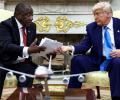
South African President Cyril Ramaphosa, a former anti-apartheid activist and freedom fighter, responded to Trump's claims at their meeting in the Oval Office diplomatically, countering Trump's assertions.
Recent measures by Indian government to push economic reforms have dispelled fears of policy paralysis, while some more steps are needed for reviving investments and ensuring that household savings go into productive sectors, top banker Chanda Kochhar said.
Indian governments enjoy brief periods of autonomy before politics take over.

N Chandrasekaran, chairman of Tata Consumer Products, has said in the company's annual report for FY25 that India remains one of the bright spots of economic growth amid a volatile global environment. He said India's long-term growth was underpinned by strong demographic and economic fundamentals as well as structural reforms.

'In the new coalition government, India's reform agenda may prioritise job creation and factor market reforms.'

'...he keeps his campaign promises, does what he said he will do which led to his huge victory.'

Rediff reports on the reasons behind this dramatic shift.
The Confederation of Indian Industry on Thursday expressed confidence that the economic reforms would continue to be a focal point whichever party forms the next government.

Opposition candidate B Sudershan Reddy appeals to MPs to vote with conscience in the upcoming vice presidential polls, urging them to prioritize the spirit of India and parliamentary traditions over party loyalty.

The economic reforms started by Singh as the finance minister in 1991 gave a new direction to India as it ushered in a liberal economy, Gadkari said.

It is time for India to raise its voice not just through military prowess, but through professionalism, principled voting and partnerships, asserts Deepak Mishra.

The economy is projected to clock 7.4 per cent growth.

India will need to grow at an average 7.8 per cent to become a high-income country by 2047, a World Bank report said on Friday. To achieve this goal India would require reforms in financial sector as well as in land and labour market, the World Bank said in its India Country Memorandum titled 'Becoming a High-Income Economy in a generation'.
India's economic revival also depends on the government's capacity to push through some critical policy reforms in the coming months, says the Economic Survey 2008-09, which was\npresented by Finance Minister Pranab Mukherjee in Parliament on Thursday.

Finance Minister Nirmala Sitharaman is likely to hold pre-budget consultations with industry chambers on June 20, sources said. The budget for 2024-25 fiscal is likely to be presented in Parliament in the second half of July. Industry sources said the pre-budget consultation with Sitharaman would be preceded by a meeting with Revenue Secretary Sanjay Malhotra on June 18.
RBI said aggregate demand during the year so far suggests that the shock to consumption is severe, and it will take quite some time to mend and regain the pre-COVID-19 momentum.

Never before has the need for creating an ambience for economic policy reforms been as critical as it is now, points out A K Bhattacharya.
'I had to persuade him. I think he was a sceptic to begin with, but later on he was convinced that what we were doing was the right thing to do, that there was no other way out.'

The chief adviser's decision to stay in office came two days after he told student-led National Citizen Party (NCP) leaders that he was mulling resignation as he felt "the situation is such that he cannot work", citing difficulties in working amid the failure of political parties to find common ground for change.


'When the average growth in the last three years was just 2.5%, how does that make us the fastest growing country?' 'They only tell you what has happened in the last 2 years; they are not taking into account what happened in FY21 on account of their mistakes.'

The Survey projected growth rate of 7-7.75 per cent for 2016-17 with downside risks due to weak global economic scenario.

The disbursement of the second tranche comes on a day when the International Monetary Fund is holding virtual discussions on Pakistan's upcoming budget, as the visit of its mission to Islamabad was delayed due to security concerns in the region.
ICRIER has suggested that the government hasten tax reforms by lowering peak customs duties to ensure export competitiveness of domestic industry.
For returning to trend growth of over eight per cent GDP growth and sustained low inflation of four per cent, removal of supply-side constraints and investor-friendly policy reforms are key, says Rajesh Cheruvu, Chief Investment Officer, India, RBS.
.jpg)
Expressing concern over the investment and innovation environment in India, a top US trade official has said the recent set of economic reforms initiated by the country were not enough to return to the path of robust growth.
